[Music] Zaur Nagoy – Djeguako: Live at Red Bull Music Festival Moscow


Ored Recordings produce some of the most unique and interesting music coming out of southern Russia.  They straddle the line between being a proper record label producing vital new music and preserving ancient artifacts.  Some notes about Zaur Nagoy’s release, courtesy of Ored’s Bandcamp page:

The Red Bull Music Festival took place on September 14-16 in Moscow. Red Bull conducts similar festivals around the world and every time tries to demonstrate the potential of local music and situate local sounds within a global context. The Moscow event was constructed around the same principles, with the slogan: “The unity of musical culture: from tradition to experiment.”

In regard to tradition and experiments, Ored Recordings was invited to give our perspective . Our portion was titled: Experimental Ethnographics, in which we spoke with the French documentarian, our friend and source of inspiration Vincent Moon, and the founder of the Morphine Records label, Rabih Beaini from Berlin. Vincent’s lecture and the collaborative audiovisual performance with Rabih features an experimental approach to ethnography and music and in this showcase Ored presented “original” sounds. For this we brought from Adygea the trio of Zaur Nagoy, Kazbek Nagaroko and Ramazan Daur – famous for their ensemble Zhyu, the film “Bonfires and Stars,” and our releases of their music.

At the last moment, due to a force majeure and only Nagoy reached the festival. For the festival, the label,and Zaur, these logistical changes became a real challenge. it became necessary to change the concept and format of the showcase.

In Circassian music, group performance is canon. In the choir (zhyu / ezhu) there is a saying: “The zhyu is a whip for a song.” The chorus of refrains and vocals largely determines the structure, rhythm and dynamics of a song. Even the outstanding Djeguako (minstrels) of the past have always had a small ensemble to back them up. At the same time, in archival records solo performance is quite common.

To this day, ethnomusicologists have been arguing as to whether or not there was mono-voiced performance before polyphony or that it is instead an indicator of the degradation of the singing tradition. Whatever it was, today, solo performance is a special, albeit not popular style of traditional Circassian music. Given the circumstances, Zaur had to demonstrate it.

For each song Zaur Nagoy gave comments on both the song’s content and context*. He did so not in an official/academic way, but with a liberating tone, reviving the story of the song with vernacular phrases and jargon. Thanks to this form of speech, the performace flet more like a ritual meeting in khachesh (guest room) combined with a stand-up show. And in the context of this release you may hear aspects similar to the genre of spoken-word.

Even if this experience of Zaur Nagoy’s solo release was an accident, we now want to work purposefully with this aesthetics and style in the future.

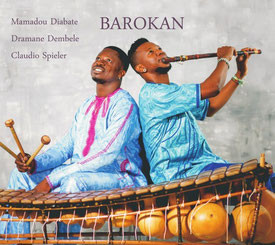
[Music] Mamadou Diabate, Dramane Dembélé, Claudio Spieler – Barokan

The month of September was rather spectacular for me.  First, I was able to see my beloved friends in Skopje, Macedonia, where people are almost as close as my own blood relatives.  The next little joy I experienced was going to the Without Borders World Music Consortium, where I had the pleasure to re-connect with comrades who spend their days promoting the best of World and Ethno Music in their respective countries.

I am especially indebted to seeing Stefanie Schumann of Delicious Tunes, who introduced me to the work of Mamadou Diabate, a balofon player originally from Burkina Faso (now residing in Vienna, Austria, if I’m not mistaken).  After being blown away by his band, who were showcased on the final evening of Without Borders (along with Breton sensations Plantec), I was given a CD which featured not only Mamadou and fellow countryman, the pelu (flute) player Dramane Dembélé and Austrian percussionist Claudio Spieler.

After having the honor of meeting Mamadou, I was given some rather impressive background information. He comes from a Samba “Jeli” family, and has several works available (all of which we hope to review in the future).

Throughout the disc, the musicians play very comfortably together, as if they had been a trio for a long time. As it turns out, Mamadou and Dramane perform together with some frequency, but Claudio’s percussion work underpins the the balafon and peul beautifully.

Where the album shines, however, is when Mamadou sings, especially on the song Koroya. His voice, in harmony with Dramane’s reminds me of the best of West African music, and the balafon adds even more body, serving, in some sense, as a third voice.

The record is pretty much flawless, and will we a welcome addition to World Music connoisseurs into their collection.  To purchase the CD, either contact Mamadou directly, or Delicious Tunes.

[Music Podcast] Mundofonías 2017 #66 | Samarcanda, Jerez, La Habana

I implore you, my friends…

Make time to catch the best World Music podcast in the world. Mundofonías‘ Juan Antonio Vázquez & Araceli Tzigane have spent years introducing an international audience to world music with their themed podcasts, and this one is no exception.

To hear this week’s episode, click here or on the image. The track list is as follows:

Zulya – Kubalagem – Aloukie
Zulya and The Children of the Underground – We twelve girls – 3 nights
Ulzhan Baibussynova – Talim – Music of Central Asia, vol.4: Bardic divas, women’s voices in Central Asia [VA]
La Banda Morisca – En toíto yo te encuentro – Algarabya
Manuel Parrilla – Bulerías “Abuelo Parrilla” – Pa mi gente
Burruezo – La mora d’Aragó – Dervishes & troubadours
Mujeres con Raíz – Sale el sol por la mañana – Las edades de la vida
Tündra – Baile de procesión – Bastardüs
Al Valdés y su Conjunto – Guajira – Cuba! Cuba! [VA]
Ignacio Carrillo – Pico y pala – Cuban playground [VA]
Rubén González Jr. – Pianísmo – Best of Cuba [VA]
Rubén González – Descarga Rubén y Cachaíto – Introducing… Rubén González [ed. 2017]
(Ska Cubano – Loca rumba – Cuban playground [VA])