[Music] Creed Taylor obituary (died 2022)

Thanks to both The Guardian and Jazz 88.3 KCCK-FM ‘s Facebook page for giving a history and eulogy of Creed Taylor, a man who changed jazz radically. He’s one worth knowing about. From the articles:

The American jazz record producer Creed Taylor (May 13, 1929 – August 22, 2022) achieved a widely envied balance between artistic quality and commercial success. His award-winning artists included the saxophonist Stan Getz, the guitarists Wes Montgomery and George Benson, whose jazz instincts he applied to songs by the Beatles, and Esther Phillips, whose disco-slanted version of What a Difference a Day Makes was one of Taylor’s last hits.

Taylor’s discovery of Brazilian music in the early 1960s, and subsequent introduction to Getz of the sound of bossa nova, led to the enormously popular albums Jazz Samba (1962) and Getz/Gilberto (1964), from which came the singles Desafinado and The Girl from Ipanema.

But there was more to Taylor’s success than million-selling albums and Grammy awards. While he had those in abundance, he was also making records that took the music in adventurous new directions. Gil Evans’s Out of the Cool (1960), the following year’s Africa/Brass by John Coltrane, Getz’s Focus and Oliver Nelson’s The Blues and the Abstract Truth – a title that Taylor invented – were milestones by even the most stringent criteria.

Taylor also insisted on a coherent visual identity, setting an example that many would follow. While other jazz producers, particularly Nesuhi Ertegun at Atlantic and Alfred Lion at Blue Note, were noted for the care they took over the visual presentation of their output, Taylor had a sharper awareness of how effectively a rack of 12-inch long-players could furnish a room.

The gatefold sleeves of the albums on his CTI (Creed Taylor Inc) label, which he began in 1966, were carefully laminated to highlight the quality of high-gloss, full-colour images by the photographer Pete Turner, usually something – a giraffe against a bright green sky, or a white concrete and glass wall curving into infinity – that bore no explicit relationship to the music but suggested a mood.

They were designed to looked as though their natural home was among the African masks, original abstract expressionist paintings and Eames chairs of a Richard Neutra-designed house set in the Hollywood Hills, intensifying their appeal to aspiring young professionals in starter homes.

Taylor was born in Lynchburg, Virginia, and grew up in Whitegate, west of Roanoke, where his father farmed land the family had owned for generations. His mother, Nina (nee Harrison), worked as a personnel director. Rather than listen to the country music with which he was surrounded, Taylor played the trumpet in high school and tuned his radio to the jazz stations, avid to hear big bands and bebop.

After studying psychology at Duke University and serving with the Marine Corps in Korea, in 1954 he moved to New York with the intention of becoming a record producer. Securing a job with Bethlehem Records, a struggling independent label, he recorded a 10-inch LP by the singer Chris Connor and the pianist Ellis Larkins, followed by albums with the bassist Oscar Pettiford and the trombonist Jack Teagarden.

In 1955 he moved on to ABC-Paramount, where he recorded a hit album called Sing a Song of Basie (1958) by the vocal group Lambert, Hendricks and Ross, and was invited in 1961 to start a new subsidiary label called Impulse, dedicated to modern jazz. There he established the formula of high-quality presentation that survived his departure to join Verve Records the following year, lured by a good offer and the chance to work with Getz, a notoriously tricky customer but one of Taylor’s favourite musicians.

Taking the risk of recording Getz with a string orchestra on modernist compositions and arrangements by Eddie Sauter to produce Focus was rewarded with critical acclaim and a Grammy. Then came the similarly award-winning bossa nova hit albums. Taylor was also recording artists as contrasting as the exuberant organist Jimmy Smith and the introspective pianist Bill Evans, whose album Conversations with Myself (1963) created pieces for three pianos through overdubbing.

In 1966 he accepted an offer from Herb Alpert and his business partner, Jerry Moss, to start his own label, CTI, under the auspices of their A&M Records. His hits over the next 10 years included Antonio Carlos Jobim’s Wave (1967), Jim Hall’s Concierto (1975), Eumir Deodato’s Prelude (1973) and Montgomery’s A Day in the Life (1967), all heavily orchestrated and illustrative of his dislike of albums that, in his view, represented little more than jam sessions captured on tape. But he also knew when to let the deeper imperatives of the music take over, as with the trumpeter Freddie Hubbard’s Red Clay and the saxophonist Stanley Turrentine’s Sugar, both released in 1970.

Jazz impresario Creed Taylor was one of the last of a dying breed of ‘record men’

Garth Cartwright

Taylor’s background as a musician helped him establish bonds with those he wanted to record. His patience enabled him to get his own way in a recording studio even when faced with a challenging temperament such as that of Nina Simone, whom he had to coax back to work midway through her final studio album, Baltimore, in 1978.

From the beginning he had known that success on his own terms would depend on understanding and working with the people who stood between his artists and the consumer: the record distributors, the promotion men and, crucially, the radio disc jockeys. But in 1978 an over-ambitious plan for CTI to handle its own distribution led to the label defaulting on repayment of a $600,000 loan from Columbia Records, filing for bankruptcy and forfeiting its entire catalogue as part of the settlement.

In 1988 Taylor was awarded more than $3m after taking legal action against Warner Bros over a dispute concerning the rights to Benson’s music.

Source: Richard Williams, The Guardian

May be an image of 1 person

All reactions:

119You and 118 others

[Music] Ellen Fullman & Theresa Wong – Harbors

Lawrence English of Room40 Records has never, not once, disappointed me in showcasing a magnificent new release. This one is a collaboration between Ellen Fullman and her long string instrument collaborating with Theresa Wong, who adds a warm layer with her cello.

From the Bandcamp website:

Harbors is a collaboration of composers Ellen Fullman (Long String Instrument) and Theresa Wong (cello), which draws inspiration from the soundscapes, stories and atmospheres that manifest around bodies of water that propagate exchange. Structured around the extended harmonics of the open strings of the cello, Wong and Fullman utilize subsets of these tonal areas to create distinct sonic environments within the piece.

Fullman’s Long String Instrument, a stunning installation of over forty strings spanning seventy feet in length, places the performers and audience inside the actual resonating body, transforming the architecture itself into the musical instrument. Wong has developed techniques that take the cello beyond tradition into a vocabulary more closely rooted in the sounds of the natural world. She captures material electronically, layering textures amplified throughout the space which form an immersive field where figure and ground are in constant flux.

The piece reveals an orchestration of shifting drones, aberrant melodies and glistening atmospheres. Harbors has reverberated many spaces around the world, including: Click Festival, Helsingør, Denmark; Transformer Station, Cleveland; MONA FOMA, Tasmania; Centennial Hall, Sydney Festival; The Lab, San Francisco; and Museum of Contemporary Art Detroit.

https://room40.bandcamp.com/album/harbors

As I am now settled in Brno, Czech Republic, these reviews will start making a comeback, and there are plans for new projects afoot. More on that later.

[Music] What is serious music?! — Stephen Jones: a blog

Stephen Jones put up a very interesting blog post in October of last year asking an eternal question vexing music fans.

*For main page, click here!* (in main menu, under WAM) I’ve just added a lengthy article on the demotion of WAM, and the flawed concept of “serious music”. It’s based on the stimulating work of Richard Taruskin on the “classical music crisis” prompted by the defection of critics to pop music since the 1960s, as he challenges […]

via What is serious music?! — Stephen Jones: a blog

[Music] Emilie Levienaise-Farrouch – Époques

This was an accidental discovery, found browsing Youtube for new music, and it looks like luck was on my side today, as I would probably have not found out about Emilie Levienaise-Farrouch, a French pianist who has enthralled me this evening.

On her Bandcamp website, there is an incredibly detailed essay with notes discussing the album and its creation.  The paragraph which caught my attention follows:

Compared to Emilie’s 2015 debut, ‘Like Water Through The Sand’, the feel of the new album appears generally darker and grittier, though in an organic way. It’s more grounded and less cold, with the piano recorded using warmer microphones and preamps. The string writing uses more extended playing techniques, such as bow overpressure on viola and cello, and multiphonics on bass guitar. Emilie also explains that “although the piano has always been a way of expressing how I feel and I wanted to create pieces that featured melodies, I wanted to use the fact the piano is a percussive instrument that can handle strength, rhythm and force just as well as gentle, intimate playing.” This powerful, emotive physicality is clearly audible on tracks like ‘Redux’, ‘Fracture Points’ and ‘Époques’. There are other pulsating/ rhythmical elements running through the record – from chopped up field recordings of waves (‘The Only Water’) to looped bowed bass guitar in ‘Ultramarine’, and the effects applied to the piano throughout ‘Morphee’.

Though seminal artists like Max Richter, Dustin O’Halloran and Jóhann Jóhannsson should be seen as reference points, Emilie has carved a niche of her own on her sophomore release.  All praise to 130701 and FatCat Records for releasing yet another gem.

[Interview] Alessandra Celletti

73255366_518700922304409_2270642290479333376_n

A few days ago, I had the honor of interviewing Italian pianist Alessandra Celletti, one of the most creative composers active today.  I came to know her work thanks to an old business partner named Michael Sheppard, who became her champion until his passing a few years ago.

Without further ado, here is Alessandra:


Though I know you from our conversations, can you tell us about yourself? Who you are, your background?

I’m a musician, and naturally I love music. But, first of all, I love life. I love nature, the sea, the trees and the flowers, I love all people and animals as well. I like to come upon new things. The relevance of music is that it gives meaning and emotion to everything. I’ve been playing the piano since I was six. The piano is my life, but I also adore singing. Singing is happiness. I have a classical education, but I am too curious not to look for other musical experiences, so I’m always looking for something new.

What inspired you to be a composer and pianist?

I’ve always played the piano. I started my career as a pianist playing classical authors: Mozart, Bach, Chopin, Brahms, Ravel… but at some point I felt the desire to transfer my personal emotions into music by composing myself. It felt like a natural passage.

Which composers or art movements have left a lasting influence in your compositions?
Erik Satie is my first love and I think of him as one of my milestones. I was swept away by the purity and freedom of his search. Then, I appreciate the intelligence and lightness of John Cage. But I am also into punk music, electronics, rock and, sometimes, even pop music. I love painting and the commixture of colors. For me, music is also color. Not for nothing my last album is a blue vinyl titled #cellettiblue, inspired by my favorite color. Blue, for me, is the color of freedom. Just look at the sky and you’ll understand.

How do you go about planning for and making a new album?

I had several producers for my previous albums: here in Italy, in England but also in America. I was lucky enough to have Michael Sheppard of Transparency as a producer. It was a very special human and artistic relationship and I miss him so much. Before he died, he told me that he would be in every note I played and sung… and, indeed, I can feel his presence. I want to make you party to a secret: I always think of Michael when I compose a new melody. Right now I don’t have a record label that produces me, so for my new project I resorted to Musicraiser’s crowdfunding. I really like this personal contact with my audience

What inspired this latest album?

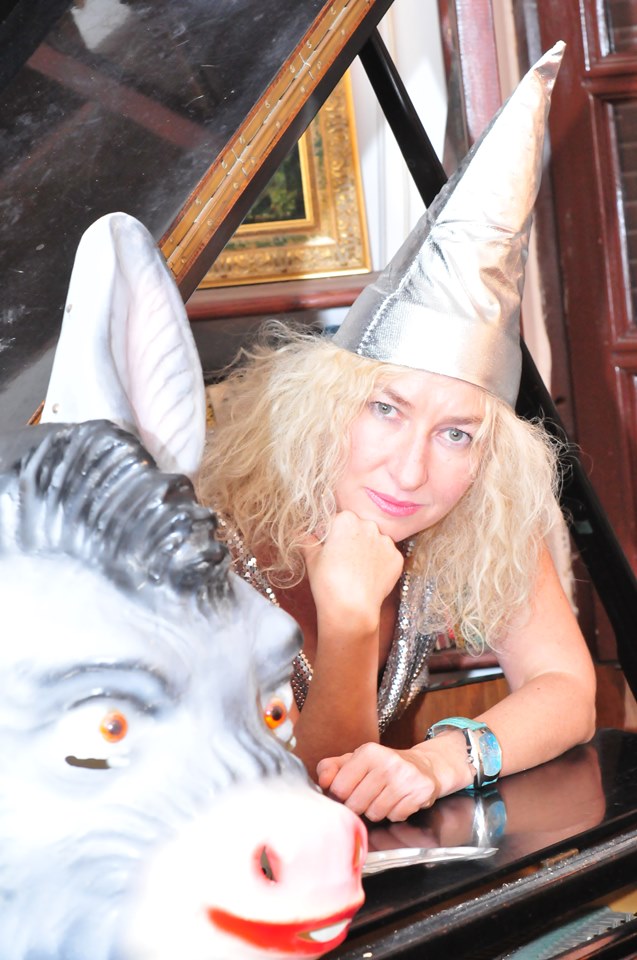
To put it simply, my love for animals. I’m working on six songs dedicated to the animals that had a special role in my life, tangible or symbolic. Among these is Pedro, a cat to whom I am connected in a magical way. And a donkey that I fantasize becoming my husband… And, last but not least, my mother, who I consider the sweetest and most wonderful of all the animals that filled my life. It is, obviously, an affectionate dedication to the person who gave me life and who flew away just a few months ago.

73458719_2678058518881227_9109541513586540544_n

Are you collaborating with anyone else these days in terms of live performance or studio collaborations?

Yes: a while ago I’ve discovered Paola Luciani and I’ve literally been bewitched by her animations. Luckily for me, this internationally recognized artist hasn’t lost the purity of her artistic expression, so I proposed a collaboration, to which she graciously agreed.
Now she’s drawing and animating her paper clippings according to an age-old and very peculiar technique. Ath the moment she is working on the donkey song and she will soon finalize the animations for the little cat Pedro (or maybe for a little bird)…

How do you feel about the state of the music business?

It seems so difficult for artists to get exposure outside of working with a major label.

How do you manage to do so well?

I simply dedicate myself to what I do with commitment and love, thinking of people with affection and trust. And – this will probably surprise you – I’m even confident in the future of music. Modes and media change all the time: vinyl, cd, streaming… but, basically, nobody can live without music.

73172186_2442017065916172_8992000808589459456_n

What projects are you working on? What should be expected to see from you in 2020?

As I said, I am working with Paola Luciani on the “Love Animals” project and I very much hope to be able to make it with Musicraiser’s help. Then, I’d like to do a lorryload of concerts and play my piano and sing these sweet songs to everyone. Even if they are dedicated to animals, they are all love songs.

https://musicraiser.com/it/projects/15090-love-animals

[Music] Eleni Karaindrou: David (ECM New Series 2221) — between sound and space: ECM Records and Beyond

Eleni Karaindrou David Kim Kashkashian viola Irini Karagianni mezzo-soprano Tassis Christoyannopoulos baritone Vangelis Christopoulos oboe Stella Gadedi flute Marie-Cécile Boulard clarinet Sonia Pisk bassoon Vangelis Skouras French horn Sokratis Anthis trumpet Maria Bildea harp Katerina Ktona harpsichord ERT Choir Antonis Kontogeorgiou choirmaster Camerata Orchestra Alexandros Myrat conductor Concert production: The Athens Concert Hall Recorded live […]

via Eleni Karaindrou: David (ECM New Series 2221) — between sound and space: ECM Records and Beyond