[Blog] SoWhat

For those of you who read Italian, SoWhat is a fine blog which covers ambient and drone music elegantly.
[Music] Creed Taylor obituary (died 2022)
Thanks to both The Guardian and Jazz 88.3 KCCK-FM ‘s Facebook page for giving a history and eulogy of Creed Taylor, a man who changed jazz radically. He’s one worth knowing about. From the articles:
The American jazz record producer Creed Taylor (May 13, 1929 – August 22, 2022) achieved a widely envied balance between artistic quality and commercial success. His award-winning artists included the saxophonist Stan Getz, the guitarists Wes Montgomery and George Benson, whose jazz instincts he applied to songs by the Beatles, and Esther Phillips, whose disco-slanted version of What a Difference a Day Makes was one of Taylor’s last hits.
Taylor’s discovery of Brazilian music in the early 1960s, and subsequent introduction to Getz of the sound of bossa nova, led to the enormously popular albums Jazz Samba (1962) and Getz/Gilberto (1964), from which came the singles Desafinado and The Girl from Ipanema.
But there was more to Taylor’s success than million-selling albums and Grammy awards. While he had those in abundance, he was also making records that took the music in adventurous new directions. Gil Evans’s Out of the Cool (1960), the following year’s Africa/Brass by John Coltrane, Getz’s Focus and Oliver Nelson’s The Blues and the Abstract Truth – a title that Taylor invented – were milestones by even the most stringent criteria.
Taylor also insisted on a coherent visual identity, setting an example that many would follow. While other jazz producers, particularly Nesuhi Ertegun at Atlantic and Alfred Lion at Blue Note, were noted for the care they took over the visual presentation of their output, Taylor had a sharper awareness of how effectively a rack of 12-inch long-players could furnish a room.
The gatefold sleeves of the albums on his CTI (Creed Taylor Inc) label, which he began in 1966, were carefully laminated to highlight the quality of high-gloss, full-colour images by the photographer Pete Turner, usually something – a giraffe against a bright green sky, or a white concrete and glass wall curving into infinity – that bore no explicit relationship to the music but suggested a mood.
They were designed to looked as though their natural home was among the African masks, original abstract expressionist paintings and Eames chairs of a Richard Neutra-designed house set in the Hollywood Hills, intensifying their appeal to aspiring young professionals in starter homes.
Taylor was born in Lynchburg, Virginia, and grew up in Whitegate, west of Roanoke, where his father farmed land the family had owned for generations. His mother, Nina (nee Harrison), worked as a personnel director. Rather than listen to the country music with which he was surrounded, Taylor played the trumpet in high school and tuned his radio to the jazz stations, avid to hear big bands and bebop.
After studying psychology at Duke University and serving with the Marine Corps in Korea, in 1954 he moved to New York with the intention of becoming a record producer. Securing a job with Bethlehem Records, a struggling independent label, he recorded a 10-inch LP by the singer Chris Connor and the pianist Ellis Larkins, followed by albums with the bassist Oscar Pettiford and the trombonist Jack Teagarden.
In 1955 he moved on to ABC-Paramount, where he recorded a hit album called Sing a Song of Basie (1958) by the vocal group Lambert, Hendricks and Ross, and was invited in 1961 to start a new subsidiary label called Impulse, dedicated to modern jazz. There he established the formula of high-quality presentation that survived his departure to join Verve Records the following year, lured by a good offer and the chance to work with Getz, a notoriously tricky customer but one of Taylor’s favourite musicians.
Taking the risk of recording Getz with a string orchestra on modernist compositions and arrangements by Eddie Sauter to produce Focus was rewarded with critical acclaim and a Grammy. Then came the similarly award-winning bossa nova hit albums. Taylor was also recording artists as contrasting as the exuberant organist Jimmy Smith and the introspective pianist Bill Evans, whose album Conversations with Myself (1963) created pieces for three pianos through overdubbing.
In 1966 he accepted an offer from Herb Alpert and his business partner, Jerry Moss, to start his own label, CTI, under the auspices of their A&M Records. His hits over the next 10 years included Antonio Carlos Jobim’s Wave (1967), Jim Hall’s Concierto (1975), Eumir Deodato’s Prelude (1973) and Montgomery’s A Day in the Life (1967), all heavily orchestrated and illustrative of his dislike of albums that, in his view, represented little more than jam sessions captured on tape. But he also knew when to let the deeper imperatives of the music take over, as with the trumpeter Freddie Hubbard’s Red Clay and the saxophonist Stanley Turrentine’s Sugar, both released in 1970.
Jazz impresario Creed Taylor was one of the last of a dying breed of ‘record men’
Garth Cartwright
Taylor’s background as a musician helped him establish bonds with those he wanted to record. His patience enabled him to get his own way in a recording studio even when faced with a challenging temperament such as that of Nina Simone, whom he had to coax back to work midway through her final studio album, Baltimore, in 1978.
From the beginning he had known that success on his own terms would depend on understanding and working with the people who stood between his artists and the consumer: the record distributors, the promotion men and, crucially, the radio disc jockeys. But in 1978 an over-ambitious plan for CTI to handle its own distribution led to the label defaulting on repayment of a $600,000 loan from Columbia Records, filing for bankruptcy and forfeiting its entire catalogue as part of the settlement.
In 1988 Taylor was awarded more than $3m after taking legal action against Warner Bros over a dispute concerning the rights to Benson’s music.
Source: Richard Williams, The Guardian

All reactions:
119You and 118 others
[Podcast] Contact-Exchange-Document: The Story of ND
In my teens and twenties, I had a few magazines I would buy which I considered to be crucial reads in order to expand my knowledge on music. Some of them, like The Wire and Audion are still active today, while others like Music From The Empty Quarter and ND Magazine have faded into the aether.
Imagine my shock when I saw a post come up on my Facebook feed, I thought it appropriate to share it with friends. Many thanks to Martin Franklin at Cassette Culture for producing this podcast, which you can hear here, and to Daniel Plunkett, whose wide breadth of knowledge contributed greatly to my music tastes three decades onward.
[Art] John Francis Dooley – Ulysses
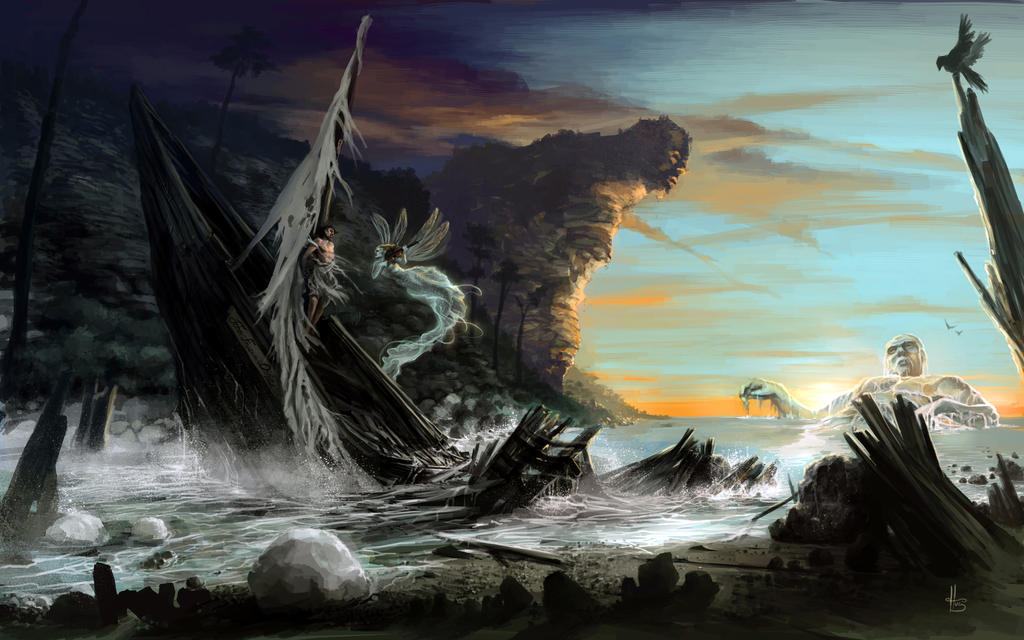
As I am currently teaching The Odyssey to my students this semester, I thought this piece of artwork would be worth sharing.
If you have ever heard the song Ulysses by the Australian world music and darkwave band Dead Can Dance, you hear John Francis Dooley being named as the protagonist of the song. There is no information about who Dooley is, and the band have been rather quiet about the meaning of the song, but a person using this name posting this painting, perhaps a digital one, based on the lyrics of the song. If there is a John Francis Dooley out there (and he sounds like he would be a perfect character for James Joyce’s book of the same name), I’d love to know more about him.
[Literature] Philologist Irene Vallejo: ‘Alexander the Great’s library was the first step towards the internet’
From The Guardian: The Spanish writer on how Papyrus, her bestselling history of literature in the ancient world, changed her life at a difficult moment, and why it’s a mistake to undervalue books.
Thanks to my colleague Jacob for introducing me to Irene Vallejo, a philologist whose work El infinito en un junco (the title in English is Papyrus: The Invention of Books in the Ancient World) introduces the concept of Alexander the Great being something of a forefather of the Internet. It’s an interesting thesis.
[Film] Instant Review
I have a terrible lack of knowledge when it comes to movies from India, especially modern ones. Thankfully, Instant Review fills the niche quite nicely.

